
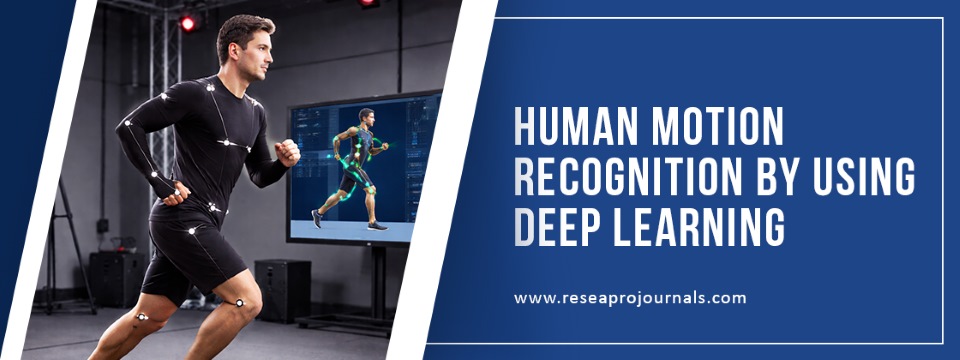
Human Motion Recognition Using Deep Learning


Introduction
Human Motion Recognition (HMR) has become a cornerstone of modern Artificial Intelligence, enabling machines to interpret and respond to human actions. From fitness tracking apps to advanced surveillance systems, this technology is reshaping how humans interact with machines.
With the rise of deep learning, motion recognition has evolved from simple rule-based systems to highly intelligent models capable of understanding complex human behaviour in real time.
What Is Human Motion Recognition in Deep Learning and Why Does It Matter?
Human Motion Recognition refers to the process of identifying and analysing human physical movements using computational models. When powered by deep learning, it uses neural networks to automatically learn patterns from data such as video frames, sensor inputs, or skeletal key points.
Unlike traditional methods, deep learning-based systems do not rely heavily on manual feature extraction. Instead, they learn directly from raw data, making them more accurate and scalable.
How Does Human Motion Recognition Work Using Deep Learning Models?
The process typically involves several steps:
1. Data Collection
Motion data is collected using:
- Cameras (RGB or depth sensors)
- Wearable sensors (accelerometers, gyroscopes)
- Motion capture systems
2. Preprocessing
Raw data is cleaned, normalized, and segmented into frames or sequences.
3. Feature Extraction
Deep learning models automatically extract features such as:
- Body joint positions
- Movement patterns
- Temporal dynamics
4. Model Training
Popular deep learning models include:
- Convolutional Neural Networks (CNNs) for spatial features
- Recurrent Neural Networks (RNNs) and LSTM for time-based motion
- Transformer-based models for sequence understanding
5. Classification and Prediction
The system classifies actions such as walking, running, sitting, or jumping in real time.
What Is the Scientific Mechanism Behind Human Motion Recognition Systems?
At its core, Human Motion Recognition relies on spatiotemporal learning, which combines spatial (body posture) and temporal (movement over time) information.
Key Mechanisms:
- Pose Estimation: Detects key body joints such as elbows, knees, and shoulders.
- Temporal Modelling: Tracks how these joints move across frames.
- Graph-Based Learning: Represents the human body as a graph where joints are nodes and bones are edges.
- Pattern Recognition: Deep networks identify recurring motion patterns for classification.
This combination allows systems to understand not just what a person looks like, but what they are doing.
Where Is Human Motion Recognition Used? Real-World Applications Explained
Human Motion Recognition has a wide range of applications across industries:
1. Healthcare
- Patient monitoring and fall detection
- Rehabilitation tracking
- Elderly care systems
2. Sports and Fitness
- Performance analysis
- Injury prevention
- Personalized training programs
3. Surveillance and Security
- Suspicious activity detection
- Crowd behaviour analysis
4. Gaming and Virtual Reality
- Gesture-based controls
- Motion capture for realistic avatars
5. Human-Computer Interaction
- Touchless interfaces
- Smart home automation
What Are the Benefits and Limitations of Deep Learning-Based Motion Recognition?
Benefits:
- High accuracy due to automated feature learning
- Real-time processing capabilities
- Scalability across different environments
- Ability to learn complex motion patterns
Limitations:
- Requires large datasets for training
- High computational cost
- Privacy concerns in surveillance applications
- Sensitivity to lighting, occlusion, and camera angles
What Is the Future of Human Motion Recognition in AI and Deep Learning?
The future of Human Motion Recognition looks promising with emerging trends such as:
- Edge AI: Processing data directly on devices for faster response
- Multimodal Learning: Combining vision, audio, and sensor data
- Explainable AI: Making decisions more transparent
- Integration with Metaverse: Real-time avatar motion mapping
- Robotics: Enhancing human-robot collaboration
As hardware becomes more powerful and datasets grow richer, motion recognition systems will become more accurate, efficient, and widely accessible.
Human Motion Recognition using deep learning is transforming industries by enabling machines to understand human behaviour with remarkable precision. From healthcare to gaming, its applications are vast and continuously expanding.
While challenges like data privacy and computational demands remain, ongoing advancements in AI are addressing these issues, paving the way for smarter and more intuitive systems.
If you're working on similar research, why not take it further? With Reseapro Journals, you can publish faster and reach a global academic audience. Start your submission today and amplify your research impact.
Reviews & Comments
No reviews yet. Be the first to write one.